Reading Rajasthan's Stepwells: A Traveller's Guide to Baoris
How to look at a baori beyond the photo stop — the engineering, the history, and where to see Rajasthan's finest stepwells.
Open guide index
How to look at a baori beyond the photo stop — the engineering, the history, and where to see Rajasthan's finest stepwells.
A stepwell is engineering before it is a backdrop
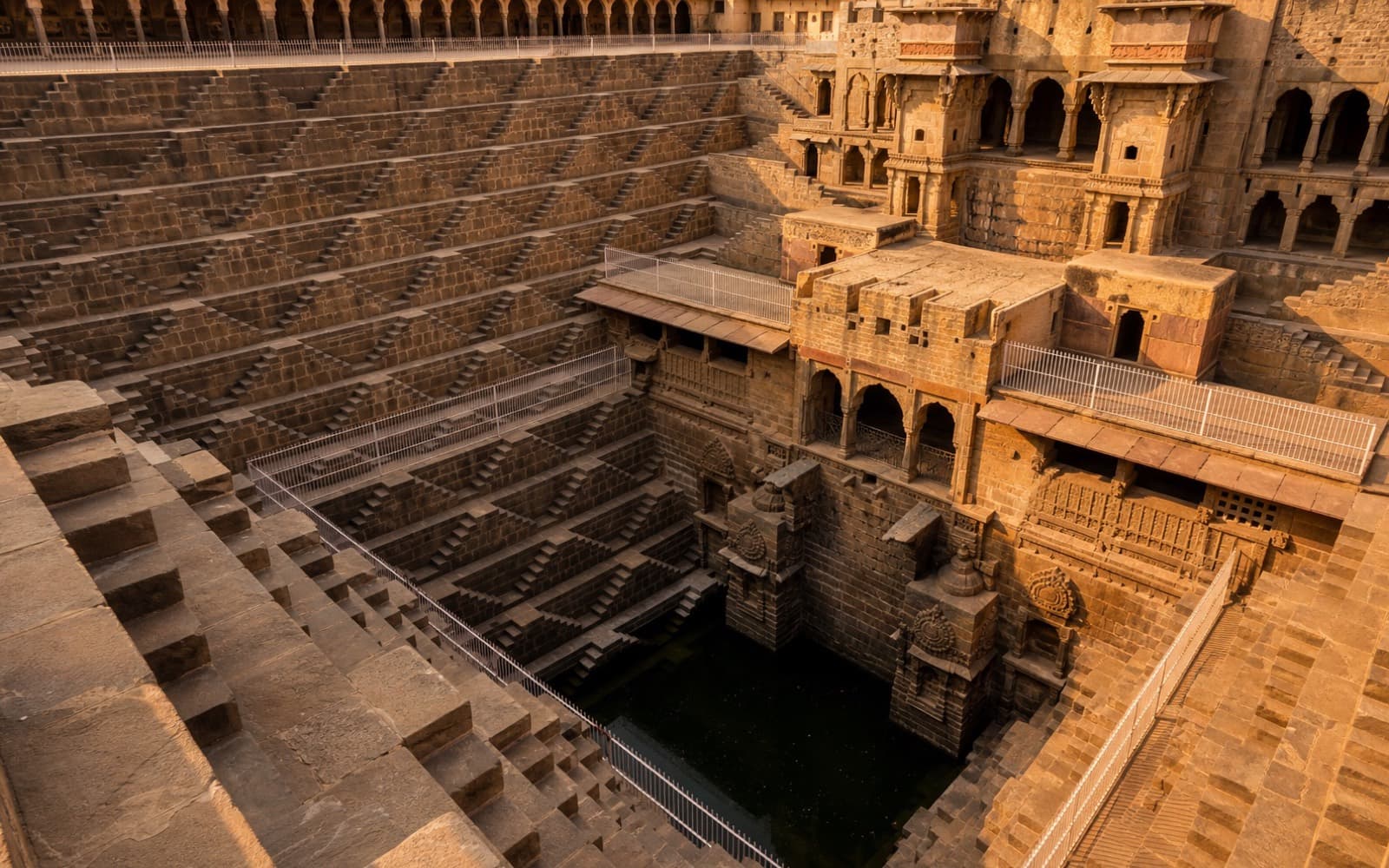
A baori is not built for the view. It is a water-harvesting system designed for a desert, reaching down through tiers of steps to a water table that rose and fell with the seasons. The geometry that makes stepwells so photogenic — those repeating, criss-crossing flights of stairs — exists so people could always reach the water, however high or low it stood.
Once you see a baori as a solution to thirst rather than a film set, the whole structure reads differently: the shaded galleries where people rested, the temples and niches built into the walls, and the cool air that still pools at the bottom on the hottest day.
Where to see Rajasthan's finest
Chand Baori at Abhaneri, near Jaipur, is the icon — thirteen storeys and some 3,500 steps in a near-perfect inverted pyramid. Panna Meena ka Kund, right by Amer in Jaipur, is smaller, easier to reach, and just as striking. Bundi, further south, is a whole town of stepwells, with the ornate Raniji ki Baori at its heart.
Many sit a short detour off the standard Jaipur–Jodhpur–Udaipur loop, which means you can fold two or three into a Rajasthan trip without rerouting it.
How to visit with care
Stepwells are old, and many steps are steep, uneven, and unrailed. Wear proper shoes, watch children closely, and do not climb onto closed sections for a photograph — both for your safety and the structure's preservation.
Several baoris are still tied to local ritual and memory, so treat them as heritage rather than props: no littering, no carving, and step back to let worshippers or locals through. The best souvenir is having understood what you were looking at.
Common questions
Frequently asked questions
What is a baori or stepwell?
A baori (stepwell) is a traditional water-harvesting structure, common in Rajasthan and Gujarat, that uses descending tiers of steps to reach groundwater far below the surface. They stored water through dry seasons and also served as cool community gathering places.
Which are the best stepwells to visit in Rajasthan?
Chand Baori at Abhaneri near Jaipur is the most famous, with around 3,500 steps. Panna Meena ka Kund beside Amer Fort is easy to reach, and Bundi has several ornate baoris including Raniji ki Baori. Many lie just off the Jaipur–Jodhpur–Udaipur route.
When is the best time to visit Rajasthan's stepwells?
October to March, when Rajasthan's weather is comfortable. Stepwells are open-air and the descents can be hot and tiring, so the cooler months make a visit far more pleasant.